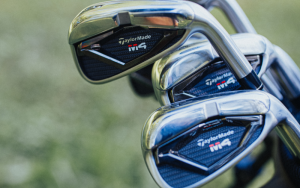
If you've just teed off and realized you have more than 14 clubs in your bag, you need to immediately declare the extra club out of play — out loud to your playing partner or marker — before you take your next stroke, and then accept the retroactive penalty strokes that come with it.
Skip that declaration step and you're looking at disqualification, so keep reading to understand exactly how this rule works and what it will cost you.
The Rule That Sets the Hard Limit
Rule 4.1b(1) is straightforward: you cannot start a round — or continue one — with more than 14 clubs.
What catches most golfers off guard is that you don't need to actually hit the extra club to be in violation. Simply having it in your possession is enough.
The rule casts a wide net on what “having” means. It covers clubs in your bag, clubs your caddie is carrying, and even clubs held by a friend walking alongside you. Ask someone to carry your bag and their contents count as yours.
A few things don't count toward the limit, though:
- Broken club parts — a detached clubhead, shaft, or grip is no longer considered a club
- A club placed in your bag without your knowledge — but only if it happened after the round started; an unknown club sitting in your bag at the first tee still counts
One more thing worth knowing: non-conforming clubs — equipment that doesn't meet the official standards — still count toward your 14 if you're carrying them.
You won't be penalized separately for having a non-conforming club, but it eats up one of your 14 slots all the same. The penalty for that comes only if you actually make a stroke with it.
What the Penalty Actually Looks Like
The penalty is retroactive, meaning it reaches back and applies to every hole you played while the extra club was in your bag — not just the hole where you discovered it. That said, there's a ceiling on the damage.
Stroke play: Two penalty strokes for each hole played in breach, capped at four strokes per round. So if you discover the extra club on the 5th tee, holes 1 and 2 each pick up two strokes. Holes 3, 4, and 5 are untouched.
Match play: The match score is adjusted by deducting one hole per hole played in breach, with a maximum of two holes. Say you're three up when you discover the breach on hole 3 — you drop to one up, regardless of how those holes were actually played.
Timing also affects how the penalty gets applied. Find the extra club while a hole is still in progress and the penalty lands at the end of that hole. Find it walking to the next tee and it's applied to the hole you just finished.
Ian Woosnam learned all of this in the most painful way possible. Standing on the 2nd tee of the final round of the 2001 Open Championship — tied for the lead after a birdie on 1 — his caddie told him there were two drivers in the bag.
Because the breach was caught before he played hole 2, only hole 1 was in breach, so he received just two penalty strokes, turning that birdie into a bogey.
He finished tied for third, four strokes behind the winner, and the mistake is estimated to have cost him £218,000 in prize money.
The One Thing You Must Do Immediately
Under Rule 4.1c(1), the moment you realize you have an extra club, you must declare it out of play before your next stroke. That's it — that's the whole job. But if you skip it, the penalty stops being a stroke adjustment and becomes a disqualification.
There's no specific script required. Any of these counts as a valid declaration:
- Tell your opponent, marker, or fellow competitor verbally
- Turn the club upside down in the bag (grip down, head up)
- Place it on the floor of the golf cart
- Hand it to someone who isn't competing in the round
The only real requirement is that your intent is clear. An unambiguous action, witnessed by someone in your group, is all the rules ask for.
Once you've declared the club out of play, that's permanent for the rest of the round. You cannot use it again under any circumstances — not for a shot, not as a measuring stick, not even in frustration. Hitting a stroke with a club you've already declared out of play means disqualification, full stop.
The whole process takes about five seconds. The penalty strokes are already coming regardless — the declaration is simply how you make sure they stay penalty strokes and don't turn into something far worse.
The Narrow Escape Window (and When It Applies)

There's a small but meaningful gap in how the rule defines a violation. A club is technically only “added” to your set the moment you make a stroke with any club while the extra one is in your possession.
That means if you spot the problem between holes and pull the club out before hitting your next shot, no breach has occurred — no penalty, no declaration needed, just quietly remove it and move on.
That window closes the second you hit your next stroke, so speed matters.
There's also a pre-round version of this escape under Rule 4.1c(2). If you discover extra clubs just before your round starts, you can declare them out of play, leave them in the bag, and they won't count toward your 14. No penalty applies.
The catch: this only works if the extra clubs ended up there by accident. If you deliberately brought 16 clubs to the first tee planning to decide later, the rule won't help you.
One area that trips people up is training aids. Alignment sticks and purpose-built training aids don't count as clubs and don't affect your limit at all. But if the item in your bag is an actual club — even one you're using as a warm-up or swing weight tool — it counts.
At the 2024 ANNIKA LPGA event, Minjee Lee received a two-stroke penalty when a training-aid club was found in her bag for exactly this reason. The rules don't care how you intended to use it, only what it is.
How Professionals Have Learned This the Hard Way
The 14-club rule has humbled some of the best players in the world, and the incidents share a common thread: the mistake itself was minor, but the consequences weren't.
Woosnam's 2001 Open Championship story is the most well-known. His caddie had left a second driver in the bag after a pre-round warm-up session. The error was caught on the 2nd tee, the penalty landed on hole 1, and a birdie became a bogey. He finished tied for third, four strokes behind David Duval — and an estimated £218,000 lighter.
Jim Furyk's 2009 experience at The Barclays stings differently because the numbers are so precise. Two identical 60-degree wedges, discovered on hole 2, triggered the full four-stroke maximum. Two pars became double bogeys on paper, dropping him from a projected tie for 6th to a tie for 15th. The cost: $131,250 in prize money and 188 FedEx Cup points.
Joel Dahmen's 2024 Shriners Children's Open incident carries the most context. Two 4-irons were spotted on the 4th tee of round one, four strokes were added, and a 72 became a 76. What made it particularly damaging was where Dahmen stood that week — 124th in the FedEx Cup Fall standings, one spot inside the threshold for keeping full PGA Tour status.
The only documented professional disqualification belongs to Philip Parkin at the 1992 Italian Open. He discovered the extra club too late, signed a scorecard that didn't include the penalty, and the incorrect card meant disqualification — not for the extra club itself, but for the signed scorecard.
Johnny Miller's 1976 case illustrates a different kind of mistake. His caddie found a 23-inch putter belonging to Miller's young son tucked in the bottom of the bag on hole 15 — and said nothing until hole 18. The penalty still reached back to hole 15, and four strokes were applied regardless.
How to Make Sure It Never Happens Again
The simplest fix is also the most obvious one: count your clubs before every round. It takes under 30 seconds and eliminates the problem entirely. Given what's at stake — as Woosnam, Furyk, and Dahmen can confirm — that's a reasonable trade.
The golfers most at risk are those who travel with 15 or 16 clubs and swap them in and out depending on the course. If that's you, the recount needs to happen at the first tee, not in the parking lot. Clubs can shift between the car and the bag, and by the time you've teed off, the window to avoid a penalty has already closed.
A few situational rules worth keeping straight:
- Team formats: Club sharing is only permitted in Foursomes and Four-Ball. In those formats, partners may share clubs as long as their combined total doesn't exceed 14.
- Multi-round events: Each round is treated independently. Carry 15 clubs across two rounds before catching the error and you're facing up to four penalty strokes per round — eight total. A playoff resets the count entirely, as it's considered a new round.
Between rounds is also a clean opportunity to fix the problem. If you realize you've been carrying an extra club, remove it or declare it out of play under Rule 4.1c(2) before the next round starts, and the slate is clean going forward.
The rule itself isn't complicated. The only thing that makes it expensive is not catching it in time.
Conclusion
Rule 4.1b is one of the more straightforward rules in golf, but it's also one of the most punishing when you're not paying attention.
The procedure when you discover an extra club is non-negotiable — declare it out of play immediately, accept the retroactive penalty, and don't touch that club again.
Everything else comes down to a 30-second count before you tee off.